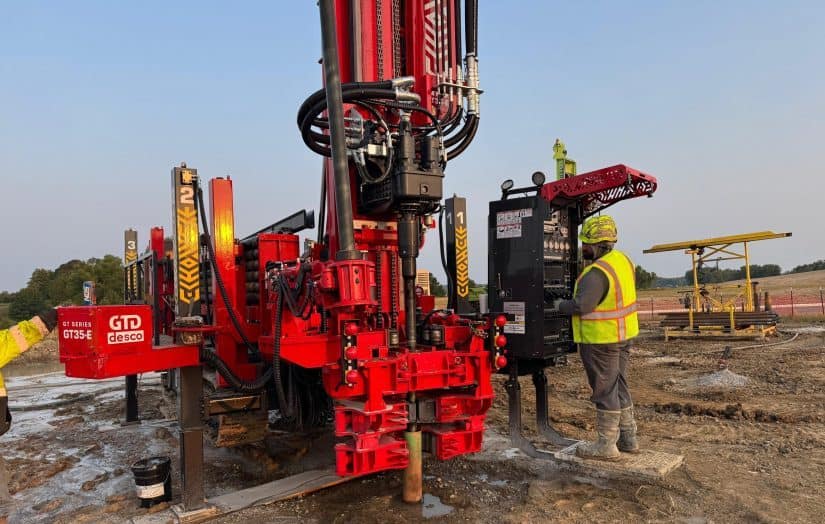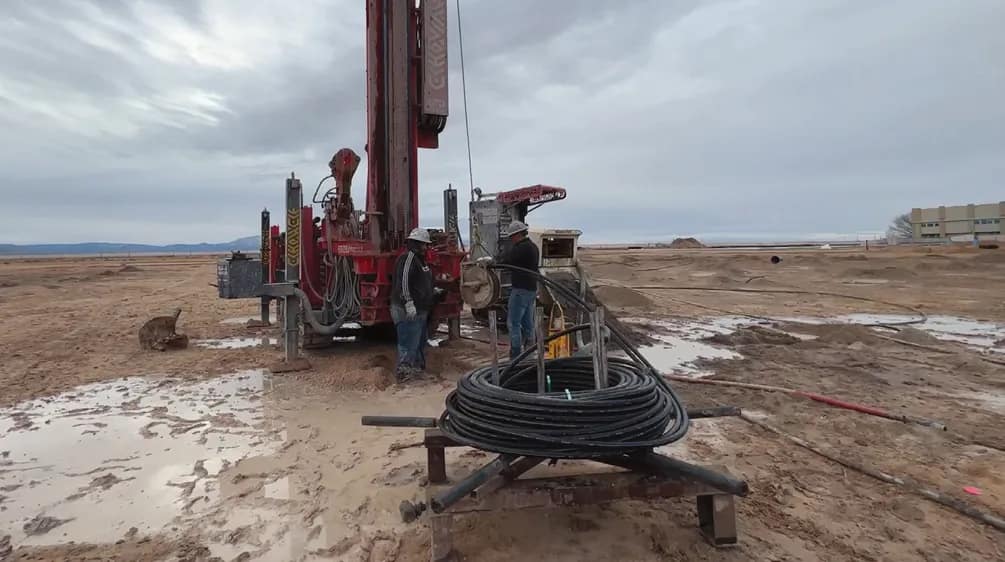
In geothermal, people get hooked on the drilling. That is understandable. Drilling is the visible part. It is noisy, technical, mechanical, and full of variables. It is the part that most naturally attracts the focus of the drilling contractors because traditional drilling industries are built around understanding geology, interpreting conditions, and adapting methods to what sits below the surface. But geothermal is different.
At its core, geothermal drilling is not about finding water, logging strata, or recovering samples. It is not exploration and it is not water well drilling. The goal is much simpler and much more brutal: Get a geothermal loop into the ground to a specified depth safely, repeatedly, and at a commercially viable speed. That is all that matters.
You can have the smartest contractor on site, the best-looking rig, the slickest solids control system, and all the shiny equipment in the world, but if the loop does not go in the hole, none of it counts. In geothermal, the borehole is only useful when it becomes a completed looped borehole. That is where the final 10% of the process becomes the most important part of the job.
The Industry Gets Distracted by the Wrong Thing
There are certainly some people in the industry who looked down on geothermal contractors who did not come from traditional drilling backgrounds. The criticism was often the same: they are not real drillers.
There is some truth in that depending on how you define drilling. Geothermal crews are not always approaching the job from a geotechnical mindset where the detail of the formation is the product. Nor are they approaching it from a water well mindset where the whole purpose is to locate, isolate, and produce water properly from an aquifer. But that misses the point.
Geothermal has its own discipline. It still requires skill. It still requires judgement. It still requires the correct method and understanding how the ground behaves. It is just judged by a different outcome.
The outcome is not whether you can describe the geology beautifully or produce the perfect core sample. It is whether you can consistently drill a clean enough hole to get the loop in the ground at pace. That is the skill.
In many ways, it is a harder commercial standard because there is nowhere to hide. Either the loop goes in or it does not.
A Clean Hole Matters More Than a Fancy Explanation
The biggest mistake on geothermal sites is confusing fast drilling with successful drilling.
Yes, the market is driven by productivity. Yes, everyone wants more feet per day. But if that speed comes at the expense of hole cleanliness, you are simply pushing a problem downstream. A dirty hole is not a drilling success waiting to happen. It is a loop installation failure waiting to happen. If you do not drill the hole clean, you make life dramatically harder for yourself when it is time to install the loop.
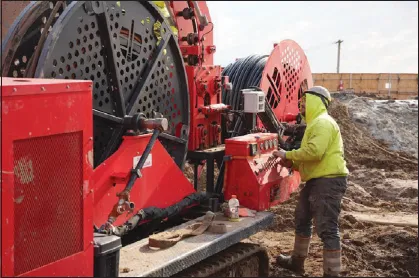
Quality loop installers allow the pipe to be fed smoothly into the holes and are critical to a geothermal job’s success. All photos courtesy Nicholas Bosch.
That is why the drilling method matters, even in a sector that is less interested in geology for geology’s sake. Air rotary, mud rotary, hammer, PDC, roller cones, casing methods, uncased methods, heavy muds, light muds, backreaming, flushing volumes, pressure, return management—all of it matters if it affects your ability to clean the hole properly.
There are endless nuances, and every formation has its own demands. You may need heavier mud to hold the formation up. You may need to backdrill to clean the hole properly on the way out. You may need bigger air. You may need bigger mud pumps, more flow, more pressure, better returns, or a slower drilling rate in a troublesome zone.
That is the real geothermal drilling skill: not simply making the hole but making a hole that is genuinely ready to receive the loop.
Everyone wants to push as fast as possible. Fair enough. But if you are drilling at maximum speed without properly cleaning the hole, you are not saving time. You are borrowing trouble.
The Loop Is the Product
Geothermal projects are not paid for drilled holes. They are paid for installed loops. That sounds obvious, but a lot of operational decisions in the field still do not reflect it.
The loop itself is the product you are trying to install: a black plastic pipe, often 1.25 inches, 1.5 inches, or 2 inches, going down to depths that might be 500 feet, 800 feet, or even 1000 feet depending on the job. The entire process should be built around getting that pipe to bottom intact and efficiently.
That means the drilling, the flushing, the dip test, the timing, the loop preparation, the filling, the weighting, the installation method, and the grouting all need to serve the same outcome.
The Best Loop Installation Starts Before the Hole Is Finished
A lot of success in loop installation is decided before the rods are even out of the ground.
A well-run geothermal crew is already thinking ahead. While drilling is underway, the loop should be being prepared. The reel should be ready. The weights, if being used, should be laid out. The loop should be filled properly. The site should be set so that as soon as the hole is finished and confirmed clear, the loop can be installed within minutes. That speed matters.
The longer a finished borehole sits open, the greater the chance of deterioration. If the hole is stable and full, keep it that way. Do not let the water column drop unnecessarily. Do not drill the hole, wander off for lunch, have a cigarette, or leave the installation until later because it suits the crew flow. The best time to install the loop is immediately after drilling, once the rods are out and the hole has been checked.
Momentum matters in geothermal. Once you lose it, jobs start to unravel.
Dipping the Holes
One of the simplest and most overlooked disciplines in geothermal is dipping the hole.
This is basic fieldcraft, but it tells you almost everything you need to know. Dip the first holes on site. Use a weight on a simple hand reel or the sandline winch to test whether the hole is genuinely clear and to understand the water level. If it stops at 250 feet, you are not putting a loop into a 600-foot hole. There is no point pretending otherwise.
That is one of the most common failures in the industry: crews lining up to install loops into holes they do not really believe are open. Everyone then acts surprised when the loop hangs up.
If the first holes are consistently clear, you gain confidence. If the same obstruction appears repeatedly at a certain depth, then you have learned something important about the formation or the method and can adjust accordingly.
Maybe that means a re-drill. Maybe it means changing drilling method. Maybe it means more flushing or a different cleaning routine. But it is far better to know that before you put the loop in than after.
Dipping is not wasted time. It is cheap insurance and takes minutes.
Filling the Loop Properly Matters
Before a loop goes in, it needs to be filled correctly.
That does not just mean putting a hose in one end and waiting until water comes out the other. Air gets trapped. Buoyancy stays in the line. People assume the loop is full when it is not. Then they wonder why installation becomes harder than it should be.
The right way is to flush the loop properly, ideally while it is laid down, using enough pressure and flow to push the air out completely. Let it run. Let the air bubbles clear. Then seal it properly. If the ends are not capped correctly, you risk losing water during installation. If the caps come off while the loop is spinning into the hole, the fluid is gone and so is one of your key advantages.
Some crews heat and squeeze the ends shut. Others use caps. Either way, the principle is the same: fill it properly, get the air out, and keep it in.
This does two things: First, it helps identify leaks before the loop is in the ground. Second, it removes a major part of the buoyancy problem. But it does not remove all of it.
Depth Creates Buoyancy, and Buoyancy Needs Beating
Even with the air removed and the loop filled, plastic pipe is still buoyant. The deeper the loop, the more pipe you have, and the more buoyancy you need to overcome. That is where weight comes in.
Across Europe and in many mature geothermal markets, the most straightforward and successful method has long been to use external weights attached to the end of the loop. These are added in sequence and dropped with the loop, with the hole overdrilled slightly to account for the additional length.
For example, on a 600-foot bore, you would likely use 3 × 88-pound weights and overdrill accordingly so they can sit below the target loop depth. The principle is simple: Get enough dead weight on the end of the loop to take it cleanly to bottom.
The advantages are obvious. It is quick. It is effective. It is a simple system. Once the hole is ready, the loop can be in the ground within minutes of the rods coming out and it requires no additional machinery.
The disadvantage is also obvious. If the loop does not go to depth and you have a weighted loop in the hole, recovery can become difficult without the right equipment. Pulling it back out by hand or with an inadequate reeler is not realistic.
But the bigger point is this: You should not be dropping a loop into a hole unless you have strong reason to believe it is going to bottom. If the hole has been drilled properly, cleaned properly, and dipped properly, the risk should be low. If it is not, the problem is not the weight system. The problem is further upstream.
Stinger Bars, Weights, and Pushers All Have a Place
There is no single perfect loop installation method for every contractor and every job.
Some use permanent or semi-permanent weighted bar systems that help drop the loops in and are then recovered. These can work well and reduce the amount of expendable weight left in the ground. The drawback is the recovery process. If the bar sticks, you can lose it. You can also risk damaging the loop while trying to pull the system back out. Like many methods, it works until it does not.
Others use expendable weights and accept the cost as part of a fast, clean process.
More recently, loop pushers (coil tube rigs) have gained attention. These are not brand-new inventions, but they have become more relevant as the geothermal market has expanded and the industry has had to absorb less experienced drilling crews at a faster rate.
A loop pusher can help push through minor restrictions, and one of its biggest advantages is the ability to pull the loop back out if it meets resistance. That can save the loop and save the hole from becoming a total loss.
That is a genuine advantage, but it is not magic. It does not create a hole for you. It does not excuse poor drilling. It does not replace the need for proper cleaning and proper field discipline. It is simply another tool.
Like every tool in geothermal, it comes with a cost. It is another machine on site, another capital outlay, another process, another layer of complexity, and another decision about whether the gain justifies the spend. For some contractors, the answer may be yes. For others, a properly drilled, properly checked, properly weighted loop installation process will still make far more commercial sense.
A good loop reeler does not have to be some massive, all-singing, all-dancing, automated system with every hydraulic or electric feature imaginable. Sometimes a good reeler is simply one that holds the loops correctly, freewheels well, is stable, and allows the pipe to feed smoothly and safely into the hole.
That is the reality of geothermal equipment. Everyone would love to own the perfect bit of kit for every situation. Most businesses cannot. So, methods need to be judged not just by technical merit, but by productivity, capital cost, crew skill level, and overall project economics.
In fact, many contractors could improve their productivity more by having a solid, sensible, properly built loop reeler than by chasing expensive complexity. Good bearings, correct support, proper loop handling, safe stability, and reliable performance matter more than gimmicks.
What does not work is skimping on this part of the operation. A badly built, unstable, damaged, or poorly thought-out reeler can turn a clean installation into a mess in seconds. If it tips over, kinks the pipe, drops the loop, or causes delays, all the drilling effort that came before it is immediately at risk.
This is the only stage that actually turns the hole into paid work. Treating the reeler as an afterthought is a mistake.
Why Loop Pushers Have Gained Ground
The rise of loop pushers is not just about technology. It is about labor, experience, and the way the geothermal market has changed.
Historically, many geothermal projects were small. A contractor might move regularly between sites and encounter a broad mix of geology over a short period. That built experience quickly. Crews learned by repetition across different formations.
Today, many projects are huge. A driller can spend months or even years on one region, one geology, one client, one style of hole. That means someone can now spend years in geothermal and still have seen a surprisingly narrow range of conditions. That is not because they are less capable. It is because the market has changed and the opportunity to build broad field experience has changed with it.
At the same time, demand has exploded. The industry needs more crews, more rigs, more output, and faster scaling. The inevitable result is that not everyone has the same depth of experience in getting loops to bottom across varied formations.
That skills gap creates demand for equipment that can compensate. That is one reason loop pushers have become more attractive. They are, in part, a response to a market growing faster than its knowledge base.
Productivity Depends on Team Structure Too
As projects get larger, the question is no longer only how you install the loop, but who should be doing it. Should the driller and rig crew own the loop installation directly? Or should there be a separate team focused purely on loops and grouting while the drillers keep drilling? There are arguments both ways.
A dedicated installation team can keep the drilling side moving and may improve total project productivity on large jobs. If the site is big enough, specialization can make sense. The rig can finish a hole, move, and be drilling again quickly while another team closes out the previous borehole.
But there is a risk in separating those responsibilities too far. If the driller knows he is responsible not just for making hole depth but for getting the loop in, he may drill with more ownership. He may clean the hole better. He may dip more carefully. He may take fewer shortcuts. If he knows someone else has to deal with the consequences, that pressure can weaken.
The best answer depends on the size of the project, the quality of supervision, and the culture of the team. What matters is that everyone understands the same truth: Nobody gets paid for a drilled hole that does not take a loop.
Ownership of that fact must remain intact, even if the labor is split.
Good Geothermal Crews Multitask
Modern geothermal rigs have removed much of the manual handling burden from drilling itself. That changes how the crew should operate.
Now that rod handling has become hands-free, the second and third men should not simply stand and watch the rig. They should be preparing the next stage. That means getting the loop ready, prepping the grout for the previous bore, organizing the installation equipment, and setting up so the job flows continuously. This is where the best geothermal crews separate themselves.
They understand that productivity is not just about how fast the topdrive turns or how quickly the rods go in and out. It is about what everyone else is doing during that same window. If the loop is prepared while drilling continues, then by the time the hole is complete, the site is ready to transition instantly to installation.
That is how you keep momentum. That is how you compress cycle times. That is how one borehole becomes several.
The Final 10% Is Where the Money Is Won or Lost
The final 10% is where the value is locked in. It is where bad drilling is exposed. It is where weak process shows up. It is where poor timing costs you. It is where cheap equipment lets you down. It is where skill, discipline, and practicality matter most.
Geothermal continues to grow quickly, and that growth has pushed the industry to focus heavily on drilling productivity, rig design, and footage per day. Fair enough. Those things matter. But the next step for the sector is to think harder about completion quality and installation flow.
Because the reality is simple.
You are not in business to drill holes. You are in business to get black pipe into the ground.
If that means drilling a little smarter, backdrilling, dipping more often, preparing loops properly, choosing the right installation method, and treating the final 10% of the process with the respect it deserves, then that is what the industry needs to do.
That is how the loop gets in and how you get paid.
Written By: Nicholas Bosch CEO and founder of GTD desco in the United Kingdom. GTD has become a leading manufacturer of geothermal-specific drill rigs in North America, specializing in highly efficient equipment for closed-loop installations that emphasize productivity and scalability. Bosch has become a regular presenter on geothermal at Groundwater Week. He can be reached at nicholas@gtd-drilling.com.
WWJ July 2026 – Link to publication click here